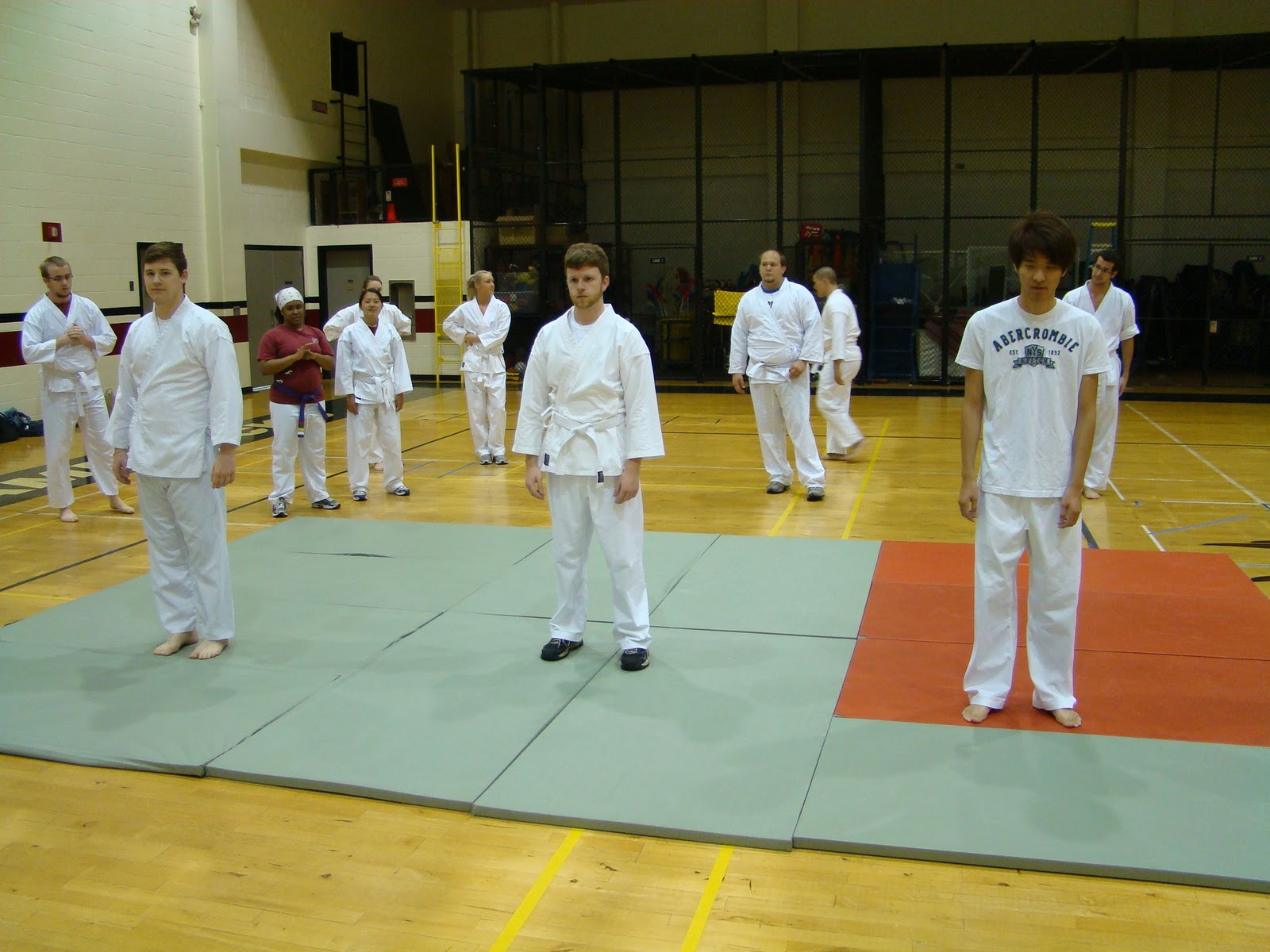
There are many styles of martial art's to chose from today. Depending on what your interests are, you have a wide variety to learn self defense from.
Of course, I happen to believe karate is one of the best, partly because it involves both kicking and punching with emphasis on good stances and power. That is the style I teach at my school, Samurai Karate Studio.
The truth is, virtually every martial art has something positive to offer the beginner student. What's probably the most important is the connection the student has with the instructor and the philosophy of the school. You train many years to achieve your black belt, so it is necessary that you feel comfortable with the school and the type of program they teach.
Here are a few styles to consider:
1. Karate -- Karate loosely translated means "empty hand". It was developed in Okinawa in the early 1920's and 1930's. Gichin Funakoshi, founder of Shotokan karate, is generally credited with having introduced and popularized karate on the main islands of Japan. After World War II, many service men stationed in Okinawa were able to train in the system. Karate is a striking art using punching, kicking, knee and elbow strikes, and open-handed techniques such as knife-hands.
2. Aikido -- Aikido is a Japanese martial art developed by Morihei Ueshiba with the goal of defending yourself without hurting your attacker seriously. The idea behind Aikido is to redirect the force of the attack rather than opposing it head-on. In other words, you use the attackers energy to defend yourself, including various joint locks and throws. While a very harsh system initially, as Morihei aged, he saw the value in developing a "peaceful" system that could prevent someone from being assaulted, yet wasn't punishing on the attacker.
3. Tae Kwon Do -- TKD is loosely translated as "the way of the hand and foot". Kicking and board breaking are a substantial element of this art. The style was developed in Korea, where today, it is a national sport. In the United States, it is one of the most popular styles, which is largely due to the TKD association which has done a very good job promoting the style.
4. Kung Fu -- Kung Fu is one of THE oldest martial arts, originating in China hundreds of years ago. It was an art developed for hand to hand combat. What makes the style unique, is the art mimics animals, popularized by the movie Kung Fu Panda. This is a very beautiful style using by power and grace in it's movements.
5. Krav Maga -- Krav Maga is the official self defense system of the Israeli Defense Forces, and has been taught to hundreds of law enforcement agencies and thousands of civilians in the United States. Krav Maga is a simple, effective self defense system that emphasizes instinctive movements, practical techniques, and realistic training scenarios.
6. Jiu-Jitsu -- There are really many forms of Jiu-Jitsu, but certainly the most popular style is based on the Gracie family. This is a legendary family from Brazil, that created a system of fighting primarily from the ground. This is a wrestling kind of style that uses locks, bars and chokes to disable an attacker. This style is very popular today with The UFC and the military offering this style of training in the Army.
Of course, there are many more styles of martial art's than the ones listed above, these are just a few of the more popular styles today.
All styles offer something of value when it comes to learning self defense. The important thing is to find a style that suits your tastes and needs.
Once you achieve the rank in one of the styles, many students will train in other styles just to compliment their self defense skills.
Warning: This course is highly contagious and could result in a more fit body and the knowledge to defend yourself!
Showing posts with label USC Curriculum. Show all posts
Monday, January 16, 2012
Friday, November 25, 2011
History of Karate
This is an excellent overview of the history of karate that will compliment the Wikipedia article mentioned in an earlier blog post.
Tuesday, November 1, 2011
Characteristics of The Samurai
As part of my training curriculum at the University of South Carolina, I ask the students to write a two page paper on the characteristics of the Samurai.
I do this so that my students can develop a better understanding of what the Samurai men and women were like. While they were legendary for their fighting skills and their sense of honor, they really were so much more than that.
Here are a few examples of papers submitted by students from earlier semesters that did a very good job of telling a story of what the Samurai were like.
I give my students a lot of latitude, so they can focus on an area that interests them, but they must present an overall picture in the life of a Samurai.
Student 1
Samurai is a term for the military nobility of pre-industrial Japan. They were part of the military class of Japanese warriors. They used weapons such as bow and arrows, spears, and guns. However, there most famous weapon was the sword. The Samurai were supposed to follow the code of Bushido. The code called for loyalty and honor to one’s master, self-discipline and respect. Some Samurai would cut their abdomens before being captured by the enemy or dying a dishonorable death. Their strength and will power shown through their behavior makes them the noble word….the samurai. Several periods over time created and shaped these warriors throughout history.
During the Heian period, the samurai’s power and strength started to grow. Landlords started to hire them to help protect their property. Near the end of this period, two military powers grew and fought against each other called the Minamoto and the Taira. These wars of supremacy were fought for years.
The next period was called the Kamakura period. During this time the Minamoto defeated the Taira and created the Minamoto Yoritomo which estabilsed a new military government in Kamakura. Here, the highest military officer would become the ruler of Japan.
The following period was called the Muromachi Period. During this time, the states within Japan were constantly battling each other for power. Because of these many wars the samurai were in great demand. Also the samurai lived on the farms and worked here as protection for their landlords.
The next period was called the Azuchi-Momoyama Period. During this time, Toyotomi Hideyoshi became the ruler of Japan and created a very rigid social caste system. He demanded that rather the samurai live and protect on the farms or work as warriors in castle towns. He also forbids anyone but the samurai to carry a sword.
The last period was known as the Edo period. During this time, the samurai stood at the top of the social system followed by farmers, then artisans then merchants. Also, the samurai were forced to live in castle towns and take their form of payment as rice from the farmers. The master less samurai were called ronin and were known to create trouble in these towns. after the fall of Osaka Castle in 1615, the Tokugawa's last potential rival was demolished, and relative peace prevailed in Japan for about 250 years. As a result, the importance of martial skills declined, and most samurai became bureaucrats, teachers or artists. In 1868, Japan's feudal era came to an end, and the samurai class completely came to an end.
Student 2
The Japanese samurai was a warrior class that existed for several centuries and followed a code called bushido or “the Way of the Warrior.” The samurai were best known for their dedication to service, especially to their masters. The ultimate honor and duty for a samurai was to give his own life for another (“Samurai”). In fact, after risking his life for the defense of his master’s castle in what seemed an impossible battle, a 16th century samurai, Torii Mototado wrote to his son that “it is not the Way of the Warrior to be shamed and avoid death even under circumstances that are not particularly important. It goes without saying that to sacrifice one's life for the sake of his master is an unchanging principle. That I should be able to go ahead of all the other warriors of this country and lay down my life for the sake of my master's benevolence is an honor to my family and has been my most fervent desire for many years” (“Samurai”).
Despite the violent aspects of samurai life, the samurai’s bushido was influenced by Buddhism and Japanese Shinto which brought about the inclusion of wisdom and serenity in their lifestyle (“Bushido”). Other rules of the bushido included “frugality, loyalty, martial arts mastery, and honor unto death” (“Bushido”). The seven main virtues of the samurai code were rectitude, benevolence, courage, honesty, respect, honor, and loyalty. Other virtues for the samurai included filial piety and care for the aged (“Bushido”).
While the samurai were expected to adhere to the bushido if one did commit transgressions there was only one way to find honor again. A fallen samurai would have to commit ritual suicide known as “seppuku” to prove he was aware of his dishonor. The act involved the samurai cutting himself through the abdomen to release his spirit and die in one of the most painful ways one can (“Bushido”).
An interesting point of the samurai lifestyle is how the women in samurai families were trained. While the main role of the women was to take care of the family and the home they were also “trained in wielding a polearm called a naginata or a special knife called the kaiken” (“Samurai”). The women were trained to use these weapons so that they could defend the family and home when the male samurai were away.
The samurai warrior class existed in Japan through the late 19th century. While Emperor Meiji abolished the samurai’s status as the only armed forces in Japan in 1873, it was not until a few years later that the samurai class truly declined (“Samurai”). However, the legend and history of the Japanese samurai is still celebrated in many modern films and other forms of pop culture.
Student 3
The way of the samurai is a very complex and idealistic practice. Their main concern was honor, and they literally defended it with their lives. In addition to pursuing a righteous lifestyle, the other prominent characteristic of samurais was their ability to pursue a life without fear. They were morally bound to the concept of bushido, which literally translates to “the way of the warrior.” To hold their family’s name in the highest social regard was of the utmost importance to the samurai, as a dishonorable lifestyle simply was not an option. The samurai were bound to fight bravely until death, and once defeated in battle they would even commit suicide in order to preserve a sense of honor. This practice, taking their own lives with a short sword, became known as the tradition of seppuku. It is no mystery that under such an idealistic and honor bound set of social principals, as to the reason that samurai were even legally granted the right to kill any commoner that failed to show them proper respect. Early samurai prided themselves as proficient archers, using longbows called “Yumi” while in battle. In fact, they originally only carried the sword to finish off their wounded enemies. As the times evolved, samurais developed new weapons such as “naginatas,” which were basically just long poles with curved blades at the end. The “daisho,” or long and short blade unison, consisted of the two swords that samurais eventually learned were more practical than just carrying a bow and spear. They carried the “katana” for longer range slashing combat, while the “wakizashi” was shorter and only used for stabbing. Samurai could be identified by their daisho, and full body armor.
The ancient art of the samurai is regarded as one of the most coveted fighting systems in the history of humankind. Through intense criticism, vigorous training methods, and a truly perfectionist state of mental discipline, these were some of the purest bred human combat machines in known existence. They were more of an evolutionary class of fighters, since they evolved from several different martial arts systems. In order for the purest definition of the modern day understanding of the samurai to come about, decades of evolution in fighting theory as well as training methods had to take shape into what is thought to be one of the most sophisticated class of soldiers in history.
Before the year 646 A.D., Japan was experiencing a social crisis in its class system and was unaware of how to properly maintain the most effective form of government. In what many would consider a corrupt and tyrannical society, the nation underwent its notorious “Taika” reforms and unknowingly laid the foundation for the beginnings of the Samurais. The new policies involved a feudal type system similar to the one already in place in Europe. As a result, land was taken from many small farmers and re-appropriated to a select few similar to Europe’s feudal “lords.” These landowners, now in possession of all the land and power in Japan, needed some form of security to protect their investments. Their answer to the thieves in search of cheating them out of their wealth: the “bushi,” or, samurai warrior.
The samurai began their endeavor into military history essentially as private security contractors, loyal only to their property masters. In some cases, the samurai were even family members to the landowners they were defending. In a reaffirmation of complete servitude and dedication to their “employer,” the samurai pledged a code of honor to the landowners they were associated with. This system of assigning private security in the form of samurais lasted for a couple hundred years, but the Japanese nation developed new problems when uprisings threatened their existing status quo. When the Heian Dynasty lost control of the rural areas in Japan sometime in the tenth century, the samurai class stepped up to restore stability and order to the areas of Japan outside of the nation’s capitol.
After taking over all major governing aspects of Japan after the year 1100, the samurai began to encounter conflicting interests in the form of disagreement amongst clans. Since they divided themselves into these family structures, known as clans, and never engrained their trust and leadership to outsiders, it was only a matter of time until their competitive natures led to turmoil and cause political unrest in Japan. After several decades of civil war and competition amongst rival clans, even the samurai generals, known as shoguns, began to encounter rivalry and threats to their leadership.
Unfortunately for the Japanese nation under Samurai rule, the all-powerful Chinese empire began to look at Japan as a possible entity for expansion. When the famous mongol ruler Kublai Khan demanded that Japan essentially bow down to his empire, the samurai clans in charge of Japan’s governing body refused. Unpleased with this decision, Khan launched a massive assault that nearly wiped the samurai clean of the pages of world history. Fortunately for those who appreciate the Samurai and their contributions to martial arts in the forms of discipline, training, and combat, two straight Chinese armadas were wiped out by typhoons in route to destroying Japan.
During Khan’s assault on Japan, the samurai were able to fight off the invading Chinese forces while protecting their existing culture and way of life. The shoguns, which at this time were leading Japan, were unable to re-pay the samurai for their service to the nation. While the shogun viewed their military actions as noble, the samurai still thought of themselves as mercenaries like in the days of feudal land-ownership. Demanding pay that simply was not available to them, the samurai launched a political uprising that once again changed the course of Japanese history as well as the modern-day definition of the word “samurai.” Japan reverted back to samurai rule, which offered relatively little stability. Since the nature of the samurai is to be an almighty and dominant force in daily life, this philosophy transcended into years of competition and basically sent Japan into decades of problematic leadership. After the “Warring States Period” and dozens of regime changes in Japan, the country essentially evolved from electing shogun after shogun and turned a new leaf so to speak. When their society began to adopt democratic ideals like public voting, the samurai lost their rule of Japan.
Monday, October 10, 2011
Take Downs
This will be a short review of the two basic take downs we work in class.
The idea is to take your attacker down, regardless of their size. This can be quite challenging for a smaller woman, however, if the techniques are applied properly, size really won't matter and you will be able to take down any person if necessary.
Take Downs
For beginner students, I focus on two basic take down concepts.
1. The first one is to place your hip (right hip in this example) against the right hip of your attacker. You want to place your right heel behind your attackers right heel. Your hands should be on both shoulders of your attacker.
You want to push with your right hand and pull with your left hand, creating a circular motion with the attackers upper body. At the same time, you want to press your hip into your attackers hip and keep the attackers right leg secure.
The concept behind this take down is to rotate the attackers upper body around your hip and drop them to the ground.
2. The second basic take down is particularly effective against a larger attacker. You want to place your hands in the same position as the previous take down was described, but this time, you want to plant your right foot around the attackers right leg and place the ball of your foot in between his legs. Your heel is up just before the moment of take down. When you drive your heel down, it straightens your leg and rises up against the attackers and should have the effect of taking the attacker off balance onto one leg. You rotate the upper body at the same time the heel drops and you should be able to drop your attacker to the ground.
Sensei Chris Feldt
Samurai Karate Studio
Columbia, SC 29229
803-462-9425
samuraikaratestudio@gmail.com
The Power of Your Voice
Your Voice As A Weapon
You feel threatened, but are unsure of the intentions of the person you are talking
to.
What can you do?
You have the power of your voice to help avoid confrontation whenever possible.
The trick is to learn what level is needed in order to engage the attacker. Here is a
glimpse at what I believe the 4 levels are and the type of voice used.
Level 1
Non-Threatening, Uncomfortable Behavior
Office, mall or grocery store, conference room
If you are uncomfortable with the persons behavior!
Tell that person in a calm way to stop that behavior.
Avoid saying please!
you want to be seen as assertive.
If that person does not stop threatening behavior!
Trust your instincts
Move to a safe zone
Level 2
Non Threatening-Public place
Restaurant, mall, store or parking lot.
You are not isolated.
Make a scene!
Be loud enough for people to hear you.
This may embarrass the person confronting you and cause them to stop.
Keep your eyes on the person the whole time!
Call for help or move to safe zone!
Level 3
Threatening Behavior
Try to defuse or de-escalate
Best example of defusing situation!
Offer up wallet or credit cards or cash
What is the motive? (money, sex, power, murder)
Try to defuse situation!
Talk in a calm assertive voice
Let your potential attacker know that you won't be an easy prey!
Tell him you know how to defend yourself (black belt?)
Talk but don’t necessarily provoke him.
Level 4
Imminent Threat or attack
Verbal boundary of defense
Look them in the eye!
Hold out your hands in front of you!
Yell “Stay Back!” or “Stop!”!
If your attacker threatens you if you speak!
Yell, because that is exactly what he doesn’t want you to do
Yell loudly and keep yelling
Yelling “FIRE” attracts the most attention from bystanders
Yelling helps give you more power and pushes away the pain
The power of your voice means many things - the willingness to try and talk your way
out of conflict in a very civil manner, or screaming at the top of your lungs letting the
attacker no in no uncertain terms will you give up without a fight!
out of conflict in a very civil manner, or screaming at the top of your lungs letting the
attacker no in no uncertain terms will you give up without a fight!
It's another tool in the toolbox of self defense.
Use it!
Sensei Chris Feldt
Columbia, SC 29229
803-462-9425
samuraikaratestudio@gmail.com
Falling
Learning how to fall is an important aspect of your karate training. First, you will be practicing with fellow students at times during class, and need to know how to fall when being taken down during a self defense form.
Secondly, you want to know how to fall to the ground, should you get knocked down by an attacker. This is more important, as you get older and you are more susceptible to injury.
The 4 B's of Falling
Whenever you practice falling, always practice with the 4 b's:
1. Bite down (to protect your teeth and avoid biting your tongue)
2. Bare down (touch your chin to your chest)
3. Breathe in to get large
4. Breathe out as you break-fall (slap hands to ground at 45 degree angle to your body)
Always practice in the beginning from the sitting position. As you gain more confidence, you can move to a squatting position and then eventually standing tall.
Remember, even when standing tall, you will always try to get into that squatting position before reaching the ground. You DON'T want to fall like a tree in the forest -- or you might get injured.
The point of the fall is to let your bottom absorb as much of the fall as possible, as you spread the energy to your back and arms. You never want to let your spine make contact with the ground, as well as your head.
Here is the sequence of last semester's students doing a backfall:
One last thing....when you reach the ground, you want to kick your legs straight out anywhere from 6-12 inches off the ground. This will prevent you from rolling backwards and find yourself in a very awkward and dangerous position if under attack.
Sensei Chris Feldt
Samurai Karate Studio
Columbia, SC 29229
803-462-9425
samuraikaratestudio@gmail.com
Personal Space
As a general rule, I try to stay alert at all times and avoid a confrontation that involves a physical reaction to a threat.
Why?
It's just much safer to avoid confrontation than engage in it. It doesn't matter how skilled a martial artist you are, there is always a chance that the attacker will get that "one" good punch or kick in that gets you by surprise and knocks you down, or worse, knocks you out!
Personal space is a concept to think about all the time. It's kind of like your own alert status! The moment someone approaches your personal space, you should be looking for escape.
The moment that person walks into your personal space, if escape is not an option, you need to go into self defense mode.
Personal Space Rules
1. Anything approaching 20 feet from where you are standing should cause you to think about escape and avoidance.
2. As the attacker approaches, you want to maintain a minimum of two arm lengths away from your attacker at all times if possible.
Why two arm lengths? The attacker is still out of range to strike with a punch or a kick and they still can't grab a hold of you.
3. Once you have determined the attacker is going to enter 1 arms length, and you feel threatened, it is my opinion that you do whatever is necessary to protect yourself. If escape is an option, always take it; however, don't be afraid to make the first strike if you feel your life is in danger.
Personal space is a very simple concept, but one I find many beginner students don't pay attention to. In large measure, I think repeated training helps the student become more aware; thus able to avoid confrontation more often than not.
Legally, use the personal space principle in determining the threat to you and do what is necessary to survive.
Sensei Chris Feldt
Samurai Karate Studio
Columbia, SC 29229
803-462-9425
samuraikaratestudio@gmail.com
Kicks
We work on 5 basic kicks in beginner karate.....the front kick, the 1/2 round, the round, the side kick and the back kick.
All but the back kick have 2 chambers, which are utilized for more power in the kick.
Front Kick
From guard stance
Square up your hips to the front
Use the back leg (beginners)
2 chambers
Weapon is the ball of your foot
1/2 Round Kick
Use lead leg from guard stance
2 chambers
Keep knee horizontal
Weapon is the top of your foot (or toes if you have on heavy shoes)
Round Kick
Use back leg from guard stance
Don't forget to pivot that front foot to avoid ankle pressure (injury)
Keep knee horizontal (same kick as 1/2 round, just from rear leg)
Same two chambers as 1/2 round kick
Weapon is the top of your foot
Side Kick
Use lead leg from guard stance
2 chambers (first chamber points back with hip pointed at attacker)
Weapon is the heel
Back Kick
Use the rear leg from guard position
Look back over opposite shoulder to look at attacker
No chambers
Weapon is the heel
With these 5 kicks, you will be able to protect yourself in most self defense encounters. The side and back kick are generally considered the strongest and the 1/2 round and front the quickest. With practice, all of the kicks can become lethal and fast!
Sensei Chris Feldt
Samurai Karate Studio
Columbia, SC 29229
803-462-9425
samuraikaratestudio@gmail.com
Basic Elbows
On often over-looked tool in our self defense arsenal is our elbows. This is a very powerful joint in our arm and the bone is relatively strong and can inflict a powerful blow.
In beginner karate, we focus on 6 basis elbow techniques that cover a wide range of self defense situations.
Elbow # 1
This is a lateral strike with the attacker generally in front of you. You strike with inside of the elbow as you post up with the back of your hand on your chest.
Elbow # 2
This is for the attacker who is right behind you. You flick your hand out and drive your elbow straight back.
Elbow # 3
This is for the attacker that is in front of you as you move the elbow up vertical as you attempt to make contact with the tip of the elbow under the attackers chin. This is also a great covering technique, especially someone trying to hit you on the head with round house type punches or even worse, maybe a hard object like a stick.
Elbow # 4
We use the tip of our elbow and drive vertically straight down. We often use a principle called "drop heavy" where you jump down into the strike. This increases the energy when exacting your blow.
Elbow # 5
You point your elbow in a horizontal position and slide to your side as the tip of your elbow strikes the attacker.
Elbow # 6
This is the elbow where you stand like you are preparing to throw a football, and you drop heavy in a circular motion downward. This is typically an elbow that might go to the back of an attackers head who is bending over.
Obviously, I am just briefly describing the elbows here as simply as possible. We covered them in much more detail in class. The idea is to remind you of the techniques enough to jog your memory and practice them on your own or in class.
Elbows are a great "inside" tool to use when defending yourself in close to your attacker. They can unleash a mean strike and take quite a bit of abuse.
Sensei Chris Feldt
Samurai Karate Studio
Columbia, SC 29229
803-462-9425
samuraikaratestudio@gmail.com
Wrist Releases
Wrist grabs are commonly used when the attacker wants to control their victim; prevent them from escaping and/or to deliver punches or kicks to the victim.
Our first option is to always remain as alert as possible and avoid being grabbed in the first place.
But, in the event you do get grabbed, there are 3 basic principles I use to escape. Eventually, you will learn how to use these principles and apply them to nearly any kind of wrist grab situation, whether multiple attackers, grabbing from the front or from the back.
For purposes of this discussion, assume someone grabs your wrist like in the photo above (just the way we practiced in class). First thing you want to think about is to protect your head and be ready to deflect a strike. Next, flex your fist so that it is nice and strong. This will make your wrist nice and firm and strong, which will help break the grip.
In wrist grab releases, we always counterattack and focus on the thumb of the attacker, which is the weakest point in the grab.
Principle # 1
Tighten the grip, drop your elbow down and slightly forward, as you bring your wrist back towards your head. Point your thumb up and pretend you are saying to yourself "I am defending me". Just be careful not to poke yourself in the eye or chest as you bring that thumb back to your body.
Beginners often make the mistake of pulling their wrist (arm) away.....this does not weaken the grip of the thumb. You need to drop the elbow and bring the wrist back towards you.
Principle # 2
Just like the original "Karate Kid" movie, where the main characters spends hours waxing Miyagi's cars, you want to think of "wax off". You want to create a circle motion from the inside to the outside. If necessary, you can even step to the outside of your attacker to make the circle stronger.
Principle # 3
The opposite of principle 2, we are going to circle from the outside to the inside. This is actually, the strongest of the 3 releases and may be the best option to use if you have a much bigger or stronger attacker than victim. This technique puts the most pressure on the attackers wrist and if they don't let go, there is a possibility you can injure their wrist.
When practicing these releases, use a soft grip at first in order to become comfortable with the techniques and not get your wrist all raw from someone holding too tight. As you become more experienced with it, then add power to the grab.
Sensei Chris Feldt
Samurai karate Studio
Columbia, SC 29229
803-462-9425
Redirecting and Entering
The concept of redirecting and entering is a simple one, yet more difficult to execute. The idea is not to let the person threatening you grab you or make contact with a punch.
Shoulder Grab
The classic movement we covered in class is the two arm shoulder grab. This is when the attacker moves in and grabs you by the shoulders. This is dangerous because they now have control of you and can inflict harm via striking or kicking.
The idea behind redirecting is simply to bring your arms up in an outside blocking motion, making contact with your fists or forearms on your attackers mid forearms. You strike hard enough, so that the arms move outward, thus staying away from your shoulders.
Entering, you can pull down on the attackers arms and move in for a knee strike.
A Punch
As the attacker starts to throw a punch at you, use your feet to pivot to the side while you are slapping at the punching hand. (More advanced is to use an inside block and hammer the attacker forearm.)
Maintain contact with the punch hand pushing it across the front of the attackers body.
Entering, move forward as you keep pressure on the arm and kick to the knees or strike to the head of the attacker.
The concept of redirecting and entering is a very core principle that can be used in many different attacking situations. We just covered a couple in class that you can use as a beginner.
What If You Panic?
It is very common for beginner students to struggle with the timing of techniques in the beginning. It takes a lot of repetition and practice, before your body will start to act more instinctively.
If you are attacked on the street (and you can't escape) and you forgot what to do with regards to redirecting and entering; just throw your hands up to cover your head and move into the attackers chest. The attacker will usually miss the punch to your head and you will be close enough to strike or elbow to the head.
Sensei Chris Feldt
Samurai Karate Studio
Columbia, SC 29229
803-462-9425
samuraikaratestudio@gmail.com
The 4 Arts of The Samurai
The Samurai were great warriors that lived hundreds of years ago. While their primary responsibility was to serve their lord, even if it meant making the ultimate sacrifice, they would not hesitate to do that. After all, honor was a key character trait of the Samurai and giving your life in the service of your lord was a "good" death.
For all the fighting skills these men and women possessed, most people don't realize how well educated the Samurai were.
The 4 Arts of the Samurai
The Samurai studied poetry, music, art and self defense. From an early age, Samurai boys spent much of their day in class, studying the humanities as well as the sciences. They were typically well versed in religion and philosophy; as well as in math and history.
Aside from their combat training and schooling, another revealing characteristic about the Samurai was their focus on family. The family was the center of their life and they would do anything to promote it as well as protect it.
While I admire the Samurai for their legendary fighting skills, I am equally impressed with their desire for education and you can better understand why they were admired and feared throughout the land.
Sensei Chris Feldt
Samurai Karate Studio
Columbia, SC 29229
803-462-9425
samuraikaratestudio@gmail.com
Wednesday, September 21, 2011
Basic Blocks
There are 4 basic blocks that we have covered in class.
1. The rising block
This is where the top arm wraps with the front of your fist facing your ear and you rotate your arm on an angle to a position just in front and slightly above your head.
2. The down block
Your wrap for the down block is exactly the same as for a rising block. However, the blocking hand drops like a pendulum to a position slightly above the knee. There is a rotation of the forearm just before impact.
3. Inside Block
The two fists come together off of the shoulder and the outside fist is rotated to a center position in front of your body.
4. Outside Block
The bottom arm is the arm that rotates to the outside position to block. The other arm is above and covers (protects the head or upper body).
Below is a pretty good video I found on youtube that covers these for blocks. Just note, the difference on the inside block. In the video, the instructor has his other arm straight out, I teach it with your two fist together when you first learn this technique.
Remember, as you start to develop good technique with these blocks, they will become an important part of your self defense. A good block eventually becomes a good strike
Sensei Chris Feldt
Samurai Karate Studio
Columbia, SC 29229
803-462-9425
samuraikaratestudio@gmail.com
Friday, September 9, 2011
Basic Stances
Here are the basic stances we covered in class and discussed their specific applications.
These pictures here are to help you remember the physical features of them:
Attention Stance
Ready Position
Horse Stance
Front Stance
Attack Points
The human body is a wonderful living, breathing machine and comes in all shapes and sizes. Unfortunately, someone who is about to commit an assault, is usually looking for a person that is smaller and weaker; that will put up little resistance.
In order to "level the playing field", and I am thinking of a small women versus a large man, we use specific attack points on the body to defend ourselves.
For beginner karate students, I like to focus on 5 key attack points that will help you in most self defense scenarios. In class we covered these points in a lot more detail, so I will just briefly describe them here.
The Eyes
Slap, stab, punch or gouge. This is one of my favorite attack points because it can be used in so many different assault scenario's, whether standing or even in a lying down position. When you strike the eyes, they usually water, which temporarily inhibits vision, giving you time to escape. In very dangerous situations, I would give the impression of caressing the head, only to line up the eyes for a thumb gouge.
The Nose
A strike to the nose with the back of your head, or the heal of your palm can break the nose fairly easy, resulting in watery eyes and quite a bit of pain. Even pressing the upper lip at the base of the nose can cause your attacker to release you. Of course, tearing nose rings and jamming a pen up a nostril are other examples of attacking the nose.
The Groin
While most men are "hardwired" to protect the groin from a strike, it can be attacked with a punch, an elbow or grabbed with the hand(s) and twisted. Kicing the groin is an option, but it's much harder to make good contact. Instead, I like to apply a torquing action (twisting) which is quite painful and often more effective then kicking or striking.
The Knees
Many times, I will direct my smaller stature students to consider a strike to the knees, from the front or from the sides; as a first line of defense; particularly a women who is smaller than her attacker. The strongest muscle in the women's body, is usually the leg and a strike to the knee can do a lot of damage, while helping to keep some distance from the attacker.
The Toes
The toes can be a particularly effective attack point when someone has already grabbed you, either in a bear hug or by the arms. You want to target your heels on the toes when you stomp them. When you stomp, you need to bring your knee up, so that gravity will help put some energy behind the strike.
You can also grind your heel on the top of the foot and that is painful as well.
Examples of Kyusho Strike Points on the Head
Aside from these 5 targets, I also like the throat, the sides of the neck and the temples.
The reason I pick these 5 is I think they are the easiest to remember and they cover the human body from head to toe.
The reality is, there are over 500 attack points, but the point of karate and self defense, is to keep it simple. If you focus on these 5 attack points, I feel confident that you will give yourself an opportunity to escape and seek immediate help.
Sensei Chris Feldt
Columbia, SC 29229
803-462-9425
samuraikaratestudio@gmail.com
Subscribe to:
Posts (Atom)


.jpg)